

Nice vid. You seemed very comfortable. The Pursuit fins looked great 
Posts by Dan
-
-
It's a really heavy shaft so over a short distance probably not much effect, but.. I once bent the back end of a flopper slightly up like that, on a 7mm shaft, and achieved an arc shaft flight pattern. The arc became really exaggerated past about 13ft.
-
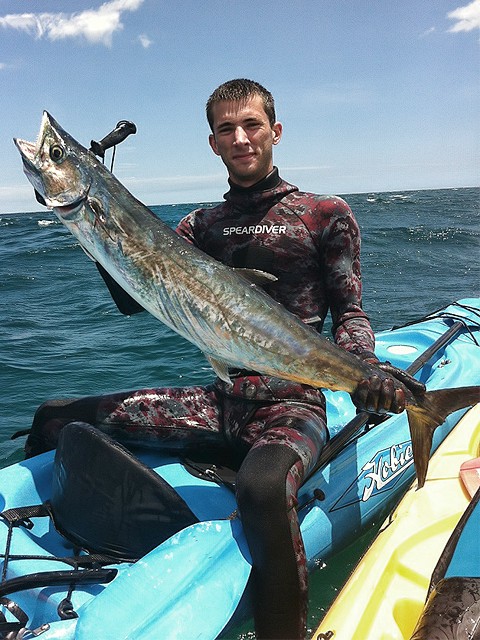
For tall and thin divers custom suits are no longer necessary. Check out Speardiver TALL and THIN Spearfishing Wetsuits.
Pictured diver is 6"1 tall and weighs 150lb wearing a size M-L (medium long) suit.

-
Oh and nice pics Gerald.
-
Thanks for the report G.
-
-
Good luck with the show.
-
It's vintage. I found the narration soothing.
Here's the answer to my question.
Quotethe fishermen cast feathered jigs into the water and haul them back systematically a few seconds later. When fish are larger than 8-15 kg, double poling may be necessary. If a tuna is caught, the movements is prolonged and the tuna lands on the vessel's deck where it releases itself from the hook (because it is barbless). The line is then ready to be thrown again
-
I don't understand how they get the fish off the hook.
-
Good to know, thanks.
-
For non forum members I can be contacted by email info@pursuitspearfishing.com
These are new, sample long freediving fins that I ordered from the manufacturer. They're one piece fins, look like a copy of the Cressi Gara. They provide good propulsion, but are a little too stiff for my liking. The size is 10-11 (44-45), I'm foot size 11 and they fit me well barefoot or with a thin Lycra sock. $75. BTW these are the Defender fins made for Persistent that sell for $144.
SOLD


-
I understand that attention needs to be drawn to the bluefin tuna problem, but you shouldn't have done it on a spearfisheman's thread on a spearfishing board as he's sharing a great achievement.
How many tuna are taken each year by spearfishermen? What percentage is this of the total tuna take? I'm guessing it's minuscule. Does it make sense that if one method of fishing, in this case long lining is really the culprit, that other methods of fishing suffer the consequences? Why should spearfishermen restrict themselves from taking tuna in the most sporting way there is?
Anyways I don't think relying on people's good will is going to achieve anything. If long lining or whatever method of take is most effective is not going to be restricted or outlawed, the only thing that will stop targeting the tuna is when there's not enough of them to make it profitable for the fisherman to be out there trying to catch them. Whether at this point there will be enough of them left to repopulate I don't know.
-
I'll take you out if the weather's good. I'm going to fix my boat this week.
-
Congratulations virgili.
Here's a copy of the article so you don't have to go to the other site. It's a good read.
QuoteDisplay MoreAN OVER 1,000 LB ATLANTIC BLUEFIN TUNA CAPTURE!
Published date : 2010-08-20

The action took place 2 days ago in the North Atlantic Coast and at about 170 miles off the coast in the direction of New Foundland
At the time the main goal of the trip was again to spot giant atlantic tuna and to do some video... In particular, at the time they do hunting herring school wich are plentifull in August there.If you plan to do this hunt the luck is the master of the game, because these great pelagics do moving all the time along the North America coast and swimming from 100 to 150 miles per day!
The weather is the second parameter, because the sea must be calm if you intend to see the "herring run" and to luckily spot tuna.
Great mako and white sharks do often take part to the quarry, this is the third unforseeable parameter..After 3 days boating in the best weather conditions, we finally could spot on the surface a predation action:

a lot of birds, two whales.Tuna were probably there hunting in a school. Each time this kind of action can last several minutes or less, then the tuna school vanishes to the depths.
I jumped from the boat among the "slaughter". Hundred and hundred birds were hunting the herrings The water temperatur was there at about 19 C degree and pretty much colder in the depth. The water was green, dirty and the visi fair at about 2 meter range . I did diving equiped with a wood speargun : the shaft with a special spear tip wich can penetrate the thick tuna skin and do not rip the meat when it get pulled.I dove at about 50feet depth where the visi was better and I could observe a couple of time massive tunas swimming fast and moving sometimes like rockets to the surface while hunting fiercely.

I have been freediving for years several times among these fishes: it's each time the same incredible and amazing "rodeo".They do coming from nowhere and eating all the fish to the last... then they take off in a split of minutes.
As usually you never find a middle size tuna because in this kind of school wich is only made of massive fish: the school was made there only of 600 to about 900lb tuna...
I did several dives from 40 to 70 ft depth but I could not spot any tuna again. Probably several hundred tuna were hunting herrings, did they move away? At the time I was thinking " aiming and shooting a giant tuna is paradoxicaly pretty hard: the target is wide, but the fish is moving fast at about 10 feet per second in changing its path all the time..." a silvery and black blue huge shape swam suddenly in front of me then under my fins...
I aimed the tuna in front of the head at about 6 feet range and shot. The shaft hit the fish in the middle of the body!The tuna vanished in a spilt of second in taking the bungee to the depth. I grabbed it and got towed as if I should be a buoy. The power of this fish is unthinkable. I speared in summer 2009 in the Strait of Gibraltar an about 1,000lb tuna and the fight lasted about 3 hours. I have been towed without a break by this huge speared fish on about 15 miles and lost it at night.

After about thirty seconds a short break,I could get back to the surface, then the tuna took off again. The fight lasted about an hour. I suddenly felt less resistance while trying to pull the line, in vain because the fish was to heavy and I could not check it. The tuna stayed motionless at about 120ft depth and I got exhausted. The fish was dead. It has been gaffed by the captain and attached at the bow then landed on the deck with a crane.
The fish could be checked: the spear tip worked perfectly, got jammed under the skin. The shaft hit first probably the spine.
Fish has not been weighted.

The length was 124" and girth 88"!!
The weigh estimated between 1,000 and 1,100lbs.
Unforgetable action!
Probably the greatest fish ever speared and landed!

-
-
In Cuba bodega just means store.
-
Sounds like a rough place to dive. A pic of your wound?
-

I've all but retired my aresenal of wood guns. These days it's either 3-prong for recreational dives or Rob Allen 120 for competitions. I recon my RA can take down 98% of anything I will run into.
This is how I think nowadays, except I prefer a simple wood gun. A Rob Allen is a simple gun. I'd like to offer such a gun except without the inconveniences, no loading butt, so so muzzle and line release etc.
-
dparache, for the back problem you can try; a rubber belt, many small evenly distributed weights, wear the belt low on the hips. Just the rubber belt and small weights and I forgot I ever had back pain while diving. If this doesn't work maybe a weight vest will help to further distribute the weight.
-
No they're not as close as could be due to your system where the mono has to go inside the mech and the loop would interfere with loading if the tab was closer. A sharkfin tab can be .25" away from the mech housing, so you lose 1" right there in your pic. You lose another 1.25" of band stretch because you can't load both bands on one tab. You're the one that brought maximizing band stretch into the conversation when you mentioned the reverse mech. Now you're saying that 2.25" of lost band stretch doesn't matter?
As I explained before the separate holes make sure that the bands don't stack on each other even if loaded on one tab. This effect is further achieved by varying the length of the wishbone slightly, making the wishbone a little longer on the bottom band.
