Posts by hank

    Went out with Doc, Duquesnay, Mo, Tino Jake and Doc's friend. Crowded boat.


    We stopped at a shallow spot inside and Tino got a nice mutton and we all got a few school masters.


    Then we went to a spot I've had on my GPS for about 8 years, given to me by my late friend Paul. I'd passed over it once but the vis was bad and I didn't stop. it's basically a hole in the sea floor. Not sure how big of a cave it is.


    Anyway, we pulled up right on top and dropped the anchor…..lucky it didn't go into the hole….and right then I could see a sand patch and I saw a big fish….snapper or grouper…pass right under us. Tino jumps in and says he saw a big cubera, goes down and shot one. Nice.
    Jake goes down and comes up with a 10 lb black grouper. Then Doc yells, "Ii found the hole". So I dive down and there it is….whoooaaaa. It kind of felt like I was getting sucked into it….eerie….and it was cold. So I stopped on top of a big rock next to it and a black appears in front of me. I start to aim and it moved behind a rock. I look up and there are 5 cuberas right in front of me. So I got one.
    I go up and tell Jake, "there's more". Before I even got to the boat, only about 30 feet away, Jake pops up and says, "you mean like this one"?….with a big smile on his face. Unreal. Jake did another dive and saw a HUGE cobia. It spooked and went into the hole. I want to get a light and see what's in there with Scuba gear. Who knows? Maybe huge grouper or cuberas? Hard to free dive and get fish out of there though.


    We went outside and got three nice barracuda, a couple hogfish and some more schoolmasters. Tino got a big blue jack.


    Then when we came home…..this is great….we were unloading the boat at Doc's house (we used his boat). DuQuesnay, who isn't one to give up on old clothes…..was walking with his basket and old baggy shorts on…..with no brief…..and his shorts dropped to his ankles. And there was this Spanish lady standing right in front of him. I saw his bare ass so I KNOW what she saw from the front. I was cracking up and told Andre, "Damn Andre…..at least ask her out on a date first…..". haha. What a day. Sorry for the bad pics. It was pretty dark when we got home.
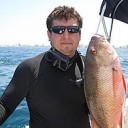
    The cooler pic is about half the fish we got.
    [/IMG]
    [/IMG]
    [/IMG]

    Here's an point to consider. Kind of which came first? The chicken or the egg?


    Are parrot fish populations less on sick reefs BECAUSE the reef is sick, meaning they lack food there? Or did the lack of parrot fish CAUSE the reef to become sick?

    No, I don't think it's bullshit. It does state that parrot fish populations are high in areas with healthy reefs so it seems obvious that they have a niche role in the systems.


    But it is a complex issue. Parrots aren't really algae eaters. Surgeon fish are. Parrots do crunch coral and I guess inadvertently consume algae growing there too. You can see what parrot fish eat. Spook one and watch him shit sand, or ground up coral. They say that's what the sand on beaches is. Parrot fish poop.


    It may be that the coral where the parrot fish are cleaning up is weak from pollution, warm temperature or a recent hurricane damage? Why doesn't he see new coral growth like I did after the El Nino of 98 in the Philippines?


    I remember the El Nino of 98. Coral bleached around the world. In Boracay, Philippines on the west side there was a beautiful coral garden….that was wiped out by the bleaching from high temperatures, then a massive wave of Crown of Thorns starfish cleaned up what was left. But, on the north and south ends of the island, where ripping tidal currents brought in new, cool water daily, there was little to no damage.


    Point being, it's hard to conclude what is really happening. One could say the crown of thorns caused the damage….but the reef was already weak. The observation made by Dustan was….where in FL? I'm not sure but maybe mile or two away, the reef was healthy.


    Phillip and I had a long conversation about the releasing of these juvenile urchins. I'm a farmer….I'm skeptical about the ability to survive in an environment that they were virtually wiped out in 30 years ago. He thinks it will work. We'll see. I'll grow his algae and larvae for him but I don't hold out a lot of hope for a revival of the species here.

    Welcome.


    Yeah man, try to hook up with someone there who dives. I'd love to dive the oil rigs up there. Some of the richest marine environments there are.


    I don't know how much water time you have….I assume you're a good swimmer? There's a lot to learn. It becomes a life style. You'll spend way too much money. Your girlfriend will dump you. <img src= " class="smiley" srcset="https://spearfishing.world/forum/images/smilies/emojione/1f606@2x.png 2x" height="23" width="23" loading="eager" data-tooltip="biggrin" aria-label="biggrin">


    Be careful. Dive safe.

    I just got this email from Phillip Dustan, the guy who's working on reproducing Diadema, or black sea urchins. He has an interesting take on parrot fish effects on the reef with no Diadema present. Following is part of his email to me.


    "I am in the Florida Keys looking at my old reef sites. The news from them is not pretty and screams for a Diadema invasion to trim down the algae. In their absence the parrotfish are eating what's left of the reef and turning it into superfine sediment that smothers living coral tissue. There are virtually no juvenile corals on the reefs. I've attached a pix fyi. It's more clear than ever that we need Diadema on the reefs."


    We're going to set up the lab here for growing algae and they're sending me a larvae culture manual that a guy in the Keys has developed over the last few years. We'll see….I mean, whatever killed all the Diadema back in the 80s must still be out there. Most likely a pathogen of some sort….virus?


    So…..I'm gonna go kill some Midnight Parrot fish now. <img src= " class="smiley" srcset="https://spearfishing.world/forum/images/smilies/emojione/1f606@2x.png 2x" height="23" width="23" loading="eager" data-tooltip="biggrin" aria-label="biggrin"> Just kidding. I'm looking forward to working with this guy though. He was on Cousteau's boat. He should have some interesting stories.

    Nice diving Marco.


    Looks like just sand bottom there. Is there some structure nearby holding those fish?


    Pulling gills out and using your spear tip to brain them…..forget your knife that day?. <img src= " height="23" srcset="https://spearfishing.world/forum/images/smilies/emojione/1f606@2x.png 2x">

    Welcome. I get lost with those Hawaiian names (my ignorance). Pics will help.


    Google will also. <img src= " class="smiley" srcset="https://spearfishing.world/forum/images/smilies/emojione/1f606@2x.png 2x" height="23" width="23" loading="eager" data-tooltip="biggrin" aria-label="biggrin">

    Welcome.


    I had a few very pleasant exchanges with Les Sage on Spearboard a few years back regarding his bigger than mine cubera snapper. <img src= " height="23" srcset="https://spearfishing.world/forum/images/smilies/emojione/1f606@2x.png 2x">

    Fish population is replenished when fish move from "safe" areas into areas where they can be harvested. If there are no safe areas then there's nowhere for fish to repopulate from. A depth limitation based on what a person can dive holding their breath creates a safe area. It's so simple I don't know how you don't get it.


    Actually most fish don't reproduce in deep water..or at least the babies don't stay there… Fish larvae generally require plankton of some sort in their early stages of life and plankton requires sunlight, which is limited in deep water.


    It might be a good place for them to hide while being stalked though. Lord knows I've had many snappers run deep beyond my diving limits.


    And I am not ashamed to admit that I'm fricken' stoked to kill fish. I'd be lying if I said I wasn't. When I see that big silver mass of a dog snapper school off in the distance, my heart races a bit….I'm thinking how to kill. We're top of the food chain predators. LIke when a cat sees a bird or something and they go into stealth mode. Hell yeah….I love that shit. :thumbup:


    Thanks for posting that.


    It does kind of confirm that statements that regulation is the key here. Night diving on a new moon does make it very easy to get fish, free or scuba diving. I had some experience doing this int he Philippines and Hawaii. If there is any moon, the fish can see you even with a light. No moon, they just sit there. And that's what the paper was pointing out also.


    Again, it's not really the method. There is no scuba spearing here in Belize but the commercial guys really depleted our parrot fish until they becomes protected and now they can't sell them.


    Also, they pointed out the humphead Wrasse as one that was depleted. That's because it's extremely valuable in Chinese restaurants and commanded a very high price. It's protected now in most areas, including the Philippines but they still bust boats with illegal catches.


    I would be happy to take anyone to my friend's place in the Philippines. He has a very nice resort in a rural village with its own little island with an area that the locals made into an MPA. We'll strap on some scuba gear and see how many fish you can get. We are selective there, just like here. See how easy it is….or isn't.

    I agree with Marco. I've grown Chanos chanos (milkfish) and tilapia in tanks for breeding. The biggest fish aren't the most productive in those species. And with shrimp, the younger "hot" little females produce more. Most growers replace them after 3-4 months because productivity drops as they age. Genetics plays into it too. One may carry the fast growth gene but not have the high productivity gene. it gets complicated.


    Big ones may produce more eggs per spawn but the frequency of spawning may decrease proportionately.


    AND, one of the best eating fish I ever shot was a 140 lb goliath. It was reeeeaaaallly good.

    I'd been reading about this for the last few months.


    It seems that one could almost rule out pollution and or chemical causes because if it were at high enough levels to kill starfish at this rate, other organisms would be affected also.


    I would guess it's a pathogen. Perhaps a virus that came in the bilge of a ship? There was a similar case with a big die off of the black sea urchin in the Caribbean and Atlantic back in the 1980s.


    We have learned a lot about viruses in shrimp over the last 20 years. But there is a lot of money at stake in the shrimp industry so there is support. Starfish and urchins….well, no one is making a lot of money off them. It takes up to two years to develop markers used to identify new virus strains. We spent over $30,000 in 2004-06 identifying Penaeus Vannamei Nodavirus, one that hit us here in 2004.