
Posts by Dan

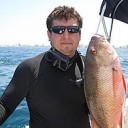
    This hog was really something special. I know that if I would have seen it I'd get that anxious feeling not to miss that I haven't felt in a long time, and have to force myself to stay calm. It was difficult to take a pic in a way that would do it justice. I asked Pantoja specifically not to hold him out towards the camera.


    This fish had a previous healed head injury. May explain why he knew to avoid divers for so long to grow so big. But he didn't count on Pantoja :)


    We went out of Haulover. Vis was hazy and we worked hard, doing many blind dives to 50-60ft as we drifted the reef. Later moving in shallower to 30 where you could just make out the bottom. Pantoja took a slew of other fish including a nice mackerel and mutton. Alan got that fat red. I had a couple of nice fish inexplicably slip of my shaft and ended up with nothing. Other than the fish the guys graciously send me home with that is. I was very happy to be diving normally for the first time in a long time, I've been having upper respiratory problems for a year now. More about this in another thread.

    Here's some information. But it says the venom gland is at the base of the spine which to me implies it's near the fish's body, whereas in the drawing it looks like it's near the end of the spine.

    Quote

    A venom gland is located at the base of each spine. After the spine punctures the skin, the venom enters the wound by traveling up a groove in the spine. Lionfish spines are not like hypodermic syringes or pit viper fangs. Instead, a loose integumentary sheath (skin) covers each spine and during envenomation, the sheath is pushed down the spine, causing compression of two venom glands located at the base. The neurotoxic venom then travels from the glands through depressions (grooves) in the wall of the spine and into the puncture wound. There have been at least four toxins identified: an antigenic heat-labile protein which is the primary toxin; acetylcholine (pronunciation: ah-see-toe-coe'-lean) which is a neurotransmitter; a neuromuscular toxin; and a low molecular weight non-proteinaceous ichthyotoxin. There is evidence that commercially available stonefish anti-venom has detoxifying effects on lionfish venom.


    Looks like you missed the pelvic fins Steven.


    Another source.


    Now my question is how close do you have to cut the fins to eliminate all possibility of a venomous sting? I mean doing it like in this pic will fix it for sure, but I'm wondering what's the minimum that needs to be cut off.


    Does anyone know with absolute certainty which are the poisonous spines on the lion fish? In other words which parts of the fish need to be removed for it to be completely safe to handle.

    Is this a custom built boat or a model that's available to anyone? I imagine it costs a bundle. Those rails must be handy to hold on to.