


Wow. Your decent rate in the first part made it seem much deeper than that.
Posts by Wishihadgills
-
-
Awesome vid. How deep was that first clip?
-
I love those golden grouper. Definitely a bucket list fish. Awesome pics Don. I agree with Judah there needs to be a book.
-
Sorry I needed a comma in there. I was referring to wanting a 1.5 suit in general, not a 1.5 chicle.
-
I would be interested in a chicle finish and a 1.5mm <img src= " height="23" srcset="https://spearfishing.world/forum/images/smilies/emojione/1f606@2x.png 2x"> . Ive heard some interesting things about them and as comfortable and warm as your suits are you might be able to sell to some of the competitive freediving community.
-
Carbon fiber is fragile in a way.. The fibers themselves are not particularly resilient to any type of damage and can easily be cut with any sharp objects. This is the reason that the carbon is combined with epoxy or other resin. The resin is to protect the fibers from cuts scrapes and other damage. Aluminum and titanium can't be scratched nearly as easily. When they do sustain scratches their strength is only changed by the amount of material removed. In most cases this is negligible. In the case of carbon fiber if a scratch is deep enough to damage fibers it's kind of like cutting part way through a rope and has a much greater impact on the strength of the objec
The are a couple misconceptions that I usually see.
One being that carbon fiber is "strong" in every way. Carbon fiber is just that, a fiber. It has an extremely high TENSILE strength to weight ratio but in compression is not remarkably strong at all. You will never see a column made of carbon fiber.
Another misconception is that carbon fiber is light and must float. CF has a specific gravity of 1.5-1.7 depending on the resin which means its 1.5 times denser than water and will sink.
The last one is probably the most important. People think that when they break composite fins they are breaking the carbon fiber itself. If you took carbon fibers before they were infused with resin you could bend them, twist them make them into just about any shape you want. They are fibers, just like a piece of rope. Now, in a fin you have a resin, and this resin is limited in how much it can flex. Resin is brittle. When the resin is asked to bend beyond its capabilities it snaps. A good resin and low resin to fiber ratio will make the best product.
Now back on topic. Dans barrels are fairly thick compared to others I have seen on the market. That being said if you swung one like a bat and hit a pole it might break but inside its intended use you would have to come up with an unreasonable scenario to ever make one fail. Assuming no manufacturing flaws (unfortunately it happens)
The strength of carbon fiber does come from the fibers, but if one or two break it wont have a significant impact because there are thousands of strands in a weave. Also Carbon fiber has a higher tensile strength than Kevlar but does not work in a vest because the fibers are fragile. Kevlar thread has much better abrasion resistance which is why it is much better suited for use in vests.
The poles mentioned are not columns. Sorry I didn't clarify but I was using the engineering definition of a column which is a member that undergoes simple compression. Sail masts that use carbon resist bending and are not under a compression load and neither are the booms.
Bike frames are also used for carbons rigidity but mostly for its light weight. Even the high end bikes they still use aluminum, titanium and tungsten alloys where large compression loads are seen. Mountain bikes frames are rarely made from carbon because they can crack. They still use aluminum frame bikes on the tour.
As for the float vs sink I have spoken to a lot of people that don't understand why carbon fiber guns sink if they flood. Its possible you haven't run into anyone who has this misconception but I have. Yes aluminum is heavier that CF but for some reason SOME people understand a metal gun wont float if its not plugged but assume a CF gun will.
-
I think I used 220 between coats and 180 for the initial prep sanding. Since your using teak I would recommend rubbing the blank with acetone half an hour before the first coat. Make sure the blank no longer smells like acetone before you start. After youve rubbed the blank with acetone wear latex gloves whenever you handle the blank.
When I moved mine to the bathroom I started getting better results. I pulled all the rugs ran hot water till the bathroom was steamed up and then let everything cool, dry and settle. Then ran the fan to evacuate the fumes while I applied the epoxy.
-
The secret to a good finish is OCD. Seriously though, the key is in the prep. The cleaner the surface and the better you prep it the better the finish. Keeping the surface oil free is extremely important. Then minimizing the dust in the room is all thats left.
It takes a lot of sanding and a lot of patience. I think I put a total of 12 coats on my gun. You only need 3-6 for a waterproof barrier. After the first 4 I wasnt happy with the finish so I sanded it almost back to bare and started over. Then someone told me a brush would be better so I tried that and found a bristly in the epoxy the next morning and that took a bit to sand out. I would recommend the expensive foam brushes at west marine. They sell cheap ones at home depot but they start to degrade after a few minutes and leave flecks of foam in the finish. It took a while but in the end I think it was worth it.
-
One technique that I learned that will help cut down on how many bubbles you have is to mix more epoxy than you ill need and then pour it into a ziploc freezer bag. The bubbles from mixing will rise to the top in the bag. Then you can cut one of the corners of the ziploc and pour from the bottom of the mix leaving the bubbles in the bag. Its basically a ghetto, disposal icing bag.
-
Ive poured 3 tracks so far. I havent worried about heating the teak and I found most if not all of the bubbles come from the epoxy itself. As long as the temperature of the wood doesnt increase while it sets youll be fine.
I would say the most important thing to do is over pour. I would suggest as much as 1/4". 99% of the bubbles will be in the top 1/8 but the epoxy will sag a little as the bubbles rise and if you only over pour by 1/8" then you run the risk of having a few bubbles in your final product.
The torch works better than the heat gun but you have to be careful not to burn the epoxy. However, the torch and heat gun only eliminate surface bubbles which will be removed when you sand down the excess. The best way to get the bubbles to come to the surface is to warm the epoxy but that will shorten the pot life of the epoxy.
I used the 207 which has a fairly long pot life but is also extra clear. It is also the most expensive. I would recommend at least the 206 but for the track its not a huge issue as all you have to do is mix and pour. The longer pot life is more important for complex fabric layups.
Another thing that I used in my tracks was graphite and west systems 403 microfibers. Rumor has it that the graphite makes the track slicker but it could be pretty marginal. The 403 fibers act as a thickening agent and increase the tensile strength of the epoxy which could help tear outs on an enclosed track but wont change much for an open track. The other benefit of the graphite is it colors the track a nice dark grey/black color. If you dont go that route and you choose to use a die be careful how much you use and only buy a quality die. If you use too much or choose a low quality die you can have curing issues. The dies are very concentrated and you would be amazed how far a drop will go.
-
I was watching a documentary on finding the giant squid and they had a bioluminescence expert with some light ball that mimicked jelly fish. Then I thought of the swordfish lights and how flashers basically reflect light. Figured it might be a good idea.
-
You can use a regular ball mill. The epoxy isn't that different from wood when working with it. I would use a slower speed and make sure the bit doesn't clog. Try a 12" pass then clear the bit and repeat.
-
Has anyone tried using swordfish lights or some other form of flashing lights as part of their flasher? If so any success?
-
I really liked the video. Its interesting to see more people in the industry doing actual research and design analysis instead of just throwing out products into the market. At least from the video it seems like this guy has put some real thought into his fins.
-
I saw this thing today and its a pretty interesting little tool. Its not very sharp like you would expect but if you put enough force into it will puncture. The other thing that makes it interesting is the location that Judah is talking about placing it. His idea is placing it on his forearm so that even fat, lazy and old people can access it without too much effort. This also makes it harder to confuse with reaching for a knife as they wont be anywhere near each other.
Personally Ill probably just use my knife but the gear whore/engineer in me will force me to try it at least once. I really appreciate the innovation; some of the coolest things in this sport came out of some guys garage. (and still do)
-
Ive yet to give it a try but I have some actual suit neoprene if you would prefer using that over mouse pad.
-
There were a couple companies that sold kill spikes like that. JBL, Rob Allen and others. I dont see a big difference in using a dedicated spike and using my knife. Just seems like one more thing to carry.
-
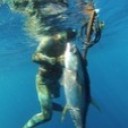
When I wear a hood it freaks me out losing one of my primary senses underwater HEARING! Cant hear boats approaching and I feel I lose all touch with my outside environment, not a pleasant feeling for me.
If you poke holes in the hood where your ears are it allows for the pressure to equalize and you can hear better. Also when you come to the surface after a dive it wont suction on your ears.
-
Im the complete opposite of you guys. One of my favorite parts of wearing a suit is the feeling of being completely covered. Nothing freaks me out more than having something brush against my skin. I feel safe in my hood looking into caves and cracks knowing I wont get lit up by fire coral. The Speardiver hood is extremely flexible and I dont find it restrictive at all.
I dont get warm or cold in a suit. I dive my 3 mil speardiver suit year round in SFL, but last summer I picked up a set of Riffe 1.5 mil pants and they were nice to have on some of the hot days.
-

Palms down is harder, you must stretch the bands more.
What do you mean by stretch the bands more?