


NOW I get it! :dumb: Yes, I think a hole saw would work to define the edge. But the guide drill in the middle of the hole saw will poke through the back of the pad, right?
Posts by Guest
-
-
I'm not sure how effectively it will chisel, since the rubber has some "give" to it.
I have an extra stopper. If you want to give me the dimensions of your stock, I can mill out the mortise in about 5 minutes and see how it turns out. I would kind of like to know myself. If you like it, then you can take it from there.
-
Hmmm. My only real question would be how to sculpt out the mortise in the rubber. I haven't tried it on a router, but that might work. The hardest part would probably be safely holding and moving the small rubber piece. A dusting of flour or something similar might help it slide more easily on the table. If you could carve out a nice, snug mortise, maybe 3/4" deep, then I think it might work great.
-
. . .Maybe the extra mass on the outer edges compresses to flat when loading spreading out the pressure evenly.
Exactly. I tried it flat at first, and I could feel a little more pressure in the center. Now it feels very uniform. Also, my dad buit a gun similar in size to mine, but a hip loader. So in playing around with the pad material, I wanted to see if it would be strong enough to keep the gun in place while hip loading. Haven't used it in the water, but it looks promising.
-
I carved it down a little more and rounded things over. In retrospect, I probably could have used the next smaller sized stopper and saved a couple bucks.


-
Hi guys,
My name is Ben. I spear off the Broward beaches.Anywhere from Commerial to Dania. I go to Nova Southeastern U, so my schedule allows me to get out during the week. So, if anyone wants to get out, shoot me a PM!
-
No, you can't polish it with steel wool. It might be possible to paint it or dip it in some sort of coating, if that coating were plyable enough not to crack with the normal deflection of the pad.
-
I found some stuff that seems to make a nice butt pad if you don't want to use the standard Riffe piece, or flip-flop section.
The material is SBR rubber, which is the stuff that they make laboratory test tube stoppers out of. It seems to be a good balance of soft, tough, and workable. Best of all, it is relatively inexpensive. These laboratory stoppers are available in quite large sizes. I used the third from the largest size that I found in McMaster, which cost about $7. They have a slight taper, and this one is 3" diameter at the small end, 3-1/2" diameter at the large end, and 1-1/2" thick. I think that they are available through about 4-1/2" diameter.
It saws easily, and can be sculpted quickly and neatly with a belt sander. A dremel will work for finer details. I mounted the pad by drilling four flat bottomed holes with a 3/8" Forstner bit, which you can get at Home Depot for about $4. I used 2" long, #8 stainless screws, and put a #6 finishing washer under the head of each screw. The finishing washer works great, because it bites out on the outside edge, and doesn't tend to pull through the rubber the way a flat washer does. I got the finishing washers at West Marine for about $0.09 each. The four screw mount feels very secure, and recessing the screw heads 1/4" was plenty deep to accomodate the compression of the rubber against my chest.
I still need to shape it a little more for looks, but I have to say it is supremely comfortable. I think this is just the ticket for either hip or chest loading. I'll never use sandal sole again.
Sorry for the large pics Dan. I mashed the wrong button. Feel free to resize if you want.


-
McMaster has black latex tubing by the foot. If that is 3/8" OD by 1/4" ID, then it is $1.06 per foot, with no minimum. Part number is 5234K74.
1/2" OD tubing is sometimes used in lightweight excercise bands, which might be available at your average Walmart, Academy, etc, but those (plus the drive to get them) will probably end up costing more than just getting it from McMaster.
-
The only wetsuit that I have every owned is my 15-yr old farmer john. Why are the two piece suits warmer? Is it because they can be made to fit tighter? Or because they don't have a zipper? I'm also not sure that I know the difference between open cell and closed cell. I have a hood that has a different material where it fits around the face. A smoother, almost rubbery feel to it. Is that open cell? I can see where a suit with that material on the inside would almost stick to your skin, and allow very little water intrusion.
Winter is when we most reliably get clear water in the bay, and much less boat traffic as well. I would love for my next suit to allow me the flexibility to freedive when conditions allow!
-
After all the fish I saw on my recent bay dive, I want something that will keep me warm enough to dive in 52-55°F water so that I can dive through the Panhandle winter. A dry suit would be a slam dunk, but I am too short have much luck looking for a used suit and can't justify the coin for new dry suit for the handful of winter dives that I can probably fit in, especially with the possibility of longer grouper season closings. Maybe "Semi-dry"?
-
-
I got to say Tin the color of that stock after a layer of penetrating oil is delicious. I hope your dad keeps making them.
I'm very glad to hear that you are happy with it, Dan. I've come to appreciate your eye for detail, so if it looks good to you than it must be a winner.
 He made about 15 or so earlier in the summer, but then interest kind of waned. He was glad to take a break, and we figured that things might pick back up when some of those stocks get shown off as finished guns. I think that he would like to do more from time to time, but it certainly goes faster if he has orders to make up a batch of several stocks at a time.
-
Some do. One of my favorite wrecks survived hurricane Ivan in 2005, only to be lost the next summer when the big ocean going tugboats towed the Aircraft carrier Oriskany out to be sunk as an artificial reef. I can only guess that the propwash from the big tugs was enought to dislodge it and send it tumbling.
The first time that we tried to prop a boat up on some cinder blocks, we found it 100' feet away the next weekend. We moved it back, proped it up, and tied it down with some home made screw in anchors (like they use to tie down mobile homes). It moved again. That is the same boat that we later moved and tied to the ring of tires. We have learned that it takes a lot to hold a lightweight fiberglass hull in place. It has stayed in place now for about two years. Once the sand has a little time to rearrange itself, the whole thing seems to reach an equilibrium with the tides and doesn't move much.
The storms do change things though. I had two good wrecks that were each made up of a smaller hull upside down and sitting inside a larger hull. In both cases, Hurricane Ivan ripped the smaller hull out and it now sits about 20' away. Another wreck was an intact 28' sportsfishing boat. Hurricane Ivan ripped the pilot house off that one, and deposited it about 30' away. That one is not nearly as productive now. Some of the heavier wrecks were also partially buried with sand. Time will tell if they will eventually uncover.
-
When I think about my general approach to diving I realize that I alway try to have zero influence on the environment other than the fish I remove.
If I were diving in an area with natural live bottom or other naturally occurring habitat, I would absolutely agree. And the Marine Patrol will BURY you (min $5000 fine in Alabama, not sure about FLA) if you get caught sinking a reef inshore. I've just taken a loose interpretation in "relocating" existing stuff that has already been down a while. <img src= " height="23" srcset="https://spearfishing.world/forum/images/smilies/emojione/1f606@2x.png 2x"> In the end, I think even the H&L guys benefit. They have no idea why the boat they sunk isn't producing fish. I can prop it up on some nearby tires or cinder blocks, and Ta-dah, grouper hotel!
-
On their side. They are open topped, with 3-4 smaller holes of 4-6" diameter placed randomly around the sides.
I happened upon them while diving once, and they were all standing upright without a fish in sight. I laid a few of them on their sides, and made it a point to dive them again a few weeks later. The sideways barrels had numerous fish, while the upright barrels had few or none. So I laid them all on their sides, and moved them close enough together that I could see them all from a central point.
They don't tend to hold fish as large a s bigger structures do, but they're often good for a keeper grouper.
-
Looking good Dan. I have an idea for a material that might make a very nice butt pad, if you don't want to use the standard Riffe style. I don't want to hijack this thread, so just PM me if you are interested. I hope to have something to show in a week or so.
-
I'm referring to the larger, wheeled, metal shopping carts in this case. The tires don't seem to attract much growth, but barnacles, anemones, and other misc. stuff readily attaches to the fiberglass boats. We don't get coral of the type that you are probably thinking of. Just an accumulation of barnacles, oysters, and a few soft spongy looking things.
I also have a spot that consists of 7 plastic 55 gallon drums with the tops cut off and a heavy chunk of concrete in the bottom. Grouper seem to love them, but no encrustation develops on the plastic.
-
The bay is sand or mud bottom through out. There are extensive grass beds in the shallows, but no natural structure (that I am aware of) in the rest. Escambia Bay and East Bay combine to form Pensacola Bay, and the whole thing drains through a single main pass to the GOM. That's why we get the substantial currents.
Fish will congregate on any available struture, even as simple as a few tires or cinder blocks. These fish will include mangrove snapper, grunts, small scamp, small gag grouper, hinds, juvenile snapper, and a few tropicals in the summer.
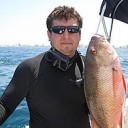
The larger grouper and snapper, however, are generally found only on wrecks that they can penetrate and hide in. People used to sink old fiberglass boats, which very often ended up up-side down. As long as there is some access for the fish, they turn into perfect hiding places. Piles of shopping baskets also make perfect grouper wrecks, because there are numeraous dead-end areas to hide in.
One of my favorite wrecks is a smalll fiberglass boat about 15' long. It happened to be sitting about 100' away from a set of about 20 tires which were tied with a rope to form a ring, with all the tires sitting upright. Until two years ago, the boat was inverted, and sucked down into the sand, with no way for the fish to get inside. So about two summers ago, we dug around it until we could lfit it with lift bags. Then we re-positioned it on top of the pile of tires. The whole thing is now about 4' tall and sits in a shallow depression with a max depth of about 36'. When I apprached it yesterday, it was covered with all manner of juvenile gags and scamp, too numerous to count. There were smaller red snapper and sheepshead circling just away from the wreck, and a steady stream of small mangroves darting in and out. I also saw two angelfish, a filefish, and a few spadefish. When I first approached, three grouper surprised me when they darted out from under the boat. Usually they will try to hide. Anyway, as I was unprepared to shoot, the first two of about 20 lb class were quickly gone. But I managed a quick hip shot and nailed the third, of about 12 lbs!