

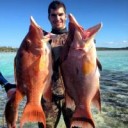
They really are incredible creatures. Im glad I was able to get such good video last year when I saw one.
Posts by Wishihadgills
-
-
In my experience the exact shape of the crimping die is less important than getting the right pressure. even with the correct die if you squeeze too hard or too light the crimp will fail. Regardless of which one you go with, ( I doubt either company makes them. they are probably rebranded crimpers from a fishing supply company) practice a few times and test your results before you put it on critical gear.
-
You can do a lot with 90x. Ive had mine for 5 years and I have used it on everything from 10ft of water shooting mangrove snapper to blue water shooting mahi mahi. It will be a little short if you find a wahoo or something more skittish. Im not real familiar with the cali spearing but for SFL 90-100cm is a very versatile length.
-
I saw a few tests a couple years ago where they filled the lungs (of some animal) with an oxygenated liquid. They are still working on the technology with hopes for applications with trauma victims, space exploration and deep diving.
It is "possible" but the technology doesnt yet exist. Who knows what the future holds.
-
Its mostly when I am at the surface. If the gopro lens is parallel with my mask lens and my face is pointed down at the bottom; if I look up (ahead of me) by moving my eyes not my head you can miss some things. If I pick my head up to try to bring the image into view of the camera the camera ends up above the water. the same can happen if you are at the very bottom and you are watching fish. I have seen it in some of your videos when you go to take the shot the fish is at the very top edge of the frame.
not sure that makes sense. I might try a diagram later tonight
-
flush with the glass or even angled a little above that. I have missed a few shots because I was looking up but the camera was angled too low.
-
Terrible loss. May he rest in peace.
-
Congrats buddy!
-
It depends on your style of diving and where you have your camera mounted. If mounted on a gun or pole it is easy to check if the camera is filming and taking short clips of action works ok. If mounted on a mask or head strap it is difficult to tell when the camera is rolling and trust me you WILL forget what it is doing.
I personally prefer to capture everything and cut out the excess. Friends of mine that selectively shoot miss a lot. You never know when something awesome is going to happen. Plus you capture a lot of filler video without even trying.
-
If my memory serves me the magnification of the 10-17 will be slightly higher than the 11-16 that frank recommended. The 11-16 will give you a wider angle and potentially allow more light in. From my understanding the EF vs MFT has more to do with which lenses you want to use. The EF uses the same attachment system as the Cannon EF lenses. If you already had cannon lenses (like I do) you would choose the EF. If not either would be available and you could pick the appropriate lens.
Im really interested in this camera but the limited battery life is a problem. Frank do you know of anything in between the DMCC and the Gopro H3+ ? Im really looking for something with a battery life of around 5-6 hours. I like to film everything that happens because you never know what might happen underwater.
-
Ill put you on the list Frank. haha.
In case anyone remembers all the way back to the last time I took this trip; I was very frustrated with shaft penetration and loosing fish. This year I had a friend of mine (one of the guys on the trip) sharpen the tips because the factory tips are terrible. We did not loose any fish as a result of under penetration and overall did not loose many fish at all. However, we did have a couple fish thrash the polespears we brought along. That big cubera snapped 500lb wire like it wasn't even there.
-
20 ft is a lot harder after a night of drinking but it has certainly changed how I view fish here. It was amazing to see such vibrant, thriving reefs.
Dan, the sharks showed up after my friend shot a decent sized mutton. When the sharks arrived so did some of the biggest muttons we had seen and our friend/pilot couldnt resist. It was a pretty exciting couple minutes to say the least.
It was an incredible trip. Can't wait to get back; hopefully I will get the chance this spring.
-
Just spent 3 days over in Walker's/Grand Cay. Had an absolutely incredible time. Here is a highlight video.
www.youtube.com/watch?v=A73PDnfVIbU
I highly recommend you watch in 1080p.
-
My family and I are taking a trip down there between christmas and new years. Anybody know any dive contacts or charters? I will be there for a little less than a week and my schedule will be pretty flexible.
Thanks in advance
Xan
-
Im more or less in the same boat you are. Im slowly adding to my gear as I venture to more and more extremes. I know you are looking for a compact setup but I am a big fan of the Rob Allen hard floats. They are streamlined, cheap (relatively) and maintain buoyancy.
I would rig similar to what you describe with 100 ft mainline either 75/25 bungie to float line or 50/50. Its a little cheaper, the float line is a little easier to handle and there is some added abrasion resistance if necessary. Attach all that to a 20L RA hard float then 25' bungie then Riffe 2 atm or some equivalent and continue to daisy chain 2 atm's for the situation at hand. Not cheap! At this point all I have is the float line and a 20L RA. Maybe Santa will drop a 2 atm and some bungee down the chimney.
I agree with Dan though, the Banks board is nice but not really intended as a large game float.
-

If you look at the PSI it inflates to it is only a 2 atmosphere float. Inflation is set for 30 PSI.
1ATM=14.7PSI=1Bar It would have to be inflated to 45 PSI to be a true 3 atm floati. But they make 60 L sizes which will float 60 Kilos=132 lbs minus the weight of the float at sea level. That is a lot of floatation but would that be enough or maybe too much without a bungee for pelagics?It is a marketing gimmick but they arent incorrect with their statement. 30 psi is a gauge pressure which is measured relative to the atmosphere. Meaning that if put in a vacuum the pressure inside the float would read approximately 45 psi. Like you mention it will only maintain max floatation down 66 but this is "technically" an absolute pressure of 3 atm. The surface pressure (air) plus 2 more atm (water).
While being marketed as 3 atm this float is really in direct competition with the riffe 2 atm float. I also agree this is probably too much lift if not coupled with a bungee or smaller float in front.
-
There is no "best card" per se. but a class 10 SDHC at the largest size supported would be best. At least a 32 gb card. Depending on what setting youre shooting at (resolution/frame rate) you can potentially fill a 32gb fairly quickly. I would recommend another card or two.
Similar to above you may or may not need a second battery. I personally like to leave my camera running the whole time im in the water so I use the battery backpack. I prefer to open or mess with the camera as little as possible.
As for the hard drive, almost any HDD will be compatible with your mac. HD video takes up a lot of space and if you are like me and never want to delete footage then you can fill it pretty quick. I recommend something in the 1 TB range. They have come down in price a bit and are pretty reasonable. They make larger ones if you need or have the cash but it takes a while to use up a TB.
For editing I highly recommend Final Cut Pro X for mac. Its simple to learn to get the basics but can be very powerful once you start to get comfortable.
Random advice. Everything appears farther away and harder to see. If you can barely see it while diving then it may not show up at all on video. I havent messed with a red/magents filter but I have heard good things. Use a rubber band to secure the case. I know the new clasp is a major improvement over the last one but a .01 precaution that could save your 400$ camera is worth it. Also depending how you have the camera mounted I would recommend a back up tether. I have seen mounts of all sorts fail and people loose cameras as a result.
Good luck and can't wait to see some awesome videos.
-
Have you ever had a sore throat the day after diving? Thats the salt fog thing. Its not the most common thing especially for people who dive regularly. Ive only had slight discomfort the next morning once or twice but that was after not diving for nearly 4 months.
Interesting idea but needs a lot of work before its ready for market.
Smith Aerospace makes a nice monofin though. It is really expensive as mentioned but I think the current US dynamic record was set with that fin.
-
In my experience the kevlar glove are much stiffer. The kevlar itself is very abrasion resistant but most of the glove on the market dont fail in the middle of a panel. Most of the gloves I have seen fail at or near the seams. Unless you are grabbing particularly slick surfaces the kevlar will be fine but I would prefer a softer material for my trigger finger. One solution is to have a different glove on your off hand that is more durable and a softer more comfortable glove on your shooting hand.
Al that aside I have been diving with the same old pair of scuba pro "imitation leather" gloves for years and I am dreading the day they finally give out cause I havent found a pair that I like nearly as much.
-
How would you keep a FAD like that in position? In shallow water an anchor or heavy weight would work but for deeper water that doesnt seem practical or effective.